skip to main |
skip to sidebar
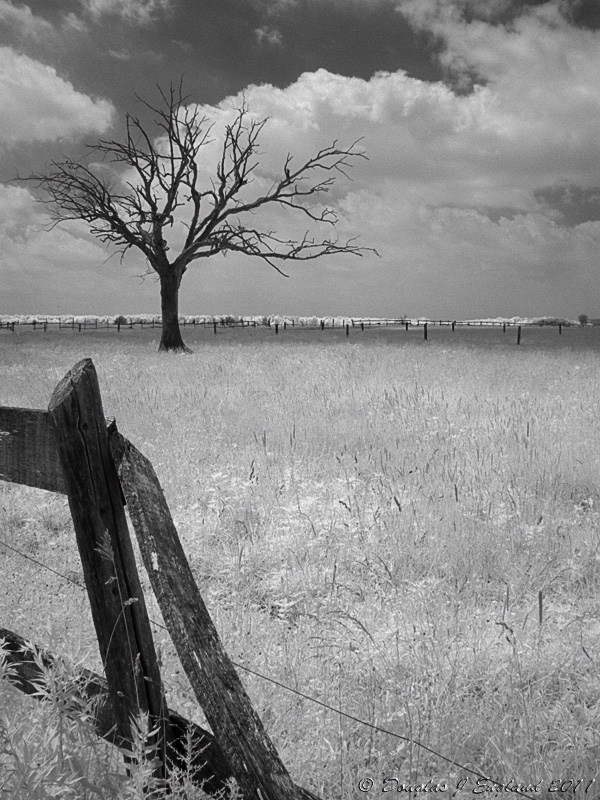
tree & broken fence

On the hottest day of the year so far, the sun was intense and blazing down on the landscape as I made my way across the flat farmland of Southwestern Ontario. The day started with an absolutely clear sky, but clouds had formed and would provide some interest for the background in a scenic image.
A lone bare tree standing in a field caught my eye and I made a number of infrared (IR) exposures before noticing a broken section of fence to use as a foreground element. Knowing the bare tree and fence boards would render as dark, almost black in IR to contrast against the white grass and clouds, I moved to find a suitable composition including the fence and creating some depth to the image.
While setting up, I noticed the shadows from the clouds sweeping over the field and waited for a moment when their shadows were approaching the tree and sunlit fields were visible on the horizon.
DJE
 Ed - In the Light II
There is a lot more to making a Black & White image from digital capture than simply setting the camera to "monochrome" and accepting what it gives you.
First off, shooting in RAW rather than jpeg gives me considerable latitude when processing the image. There are more than enough online tutorials available on this subject so I'll refrain from being redundant here. Suffice to say that I have been experimenting with some processing techniques and programs for my B&W images lately and decided to invest in some fantastic software that works with both Lightroom and Photoshop.
After installing NIK Sliver Efex Pro 2 for my B&W conversions, I was taking advantage of their online training where one tutorial used images of performing musicians to show what could be done. This gave me the idea to go back to some work I did with my cousin's band, PKK, where the strong colour cast of the stage lights was quite distracting in the colour images. The tutorial instructor was suggesting the use of Silver Efex to convert to B&W, removing colour altogether when stage lighting just can't be made to look "right".
I feel that this image of Ed, one of the band's guitarists and vocalists, is much improved with the use of a sepia monochrome conversion. I like the slight warmth retained by the sepia tone and how all but the highlights just fall into deep black background and enhance the soulful mood.
Here is the colour version of the original image for comparison.

DJE
 the lookOn the way home from the Listowel recently, I saw a young daughter and her father working at the end of the lane to their farmhouse. I had passed by but decided to turn around and grab a few images. By the time I got back they had moved quite a way from the road. My 70-200 did not have enough reach for the composition I wanted so this is a significant crop.
The heat haze and a bit 'o post gave me what I was going for ... of course the little lady provided "the look".
Opportunities like this are precisely why I always travel with a camera. It may not be my DSLR with a full range of lenses, but I can say that I never knowingly or willingly travel without at least a compact digital camera. As it happened, I had a photo backpack with some of my better gear with me on this occasion and as already stated, even that did not provide the framing I wanted for this image ... so I made use of the digital darkroom and cropped the portion of the image I visualized at capture.
I made few other exposures of the rural Ontario scene before me, trusting that I was able to capture what I needed in a couple of images. The subjects were retreating up the lane to the farm house and quickly, the moment of interest passed.
up the lane
 DJE
DJE
 jelly beans in the rain
Jelly Bean Row is not a specific street or block of houses rather a term used to describe the groupings of colourful houses in St. John's, Newfoundland.
There are ares in the city where they are sparse and others where they extend along the block on both sides of the road. Some are freshly painted, many are weathered and in need of considerable TLC.
With only a few days in St. Johns and many sights to see in the area, I left photographing these unique structures until our last day and as luck would have it, in the rain. We walked for blocks, turning corners, crossing streets enjoying the kaleidoscope of colour.
DJE
Durell, a small(er) community on the southern island of Twillingate boasts a local gem, Melvin Horwood. The locals all know him, so do countless others who have made the trek to visit Twillingate, Newfoundland and have stumbled on or received direction to his museum. After retiring from fishing in the '90's, Melvin continued to maintain his dock, stage and store and now shares with those who drop in ...
Melvin's Museum
Lynn and I had a chance encounter with Melvin when we stopped along Main St. during a morning drive. I had just parked the car to photograph another of the quaint houses perched along the shore when he just appeared ... I said "hello, you certainly have some lovely scenery here". Melvin said, "thank-you. Where are you from?" ... and it just went on from there. For the next 90 minutes we were entertained by a truly charming man.
Melvin Horwood
 Stage Security
 You just have to love the security system Melvin uses to "lock" the door of his stage museum, where all the goodies are. I should have known, when I reached for the keys to lock our car before heading down the dock, Melvin said "it's OK, you don't need to lock it" ...
'com on in

Among many other things, Melvin will show you how to throw the net to catch Capelin, the bait-fish used to catch Cod.

 throwin' the net
repeat performance (new audience)If you are
ever in Twillingate, make the time do go visit Melvin, Durell's just around the corner, literally. It will be time well spent.
DJE